

When choosing a cake board, the key is matching the board's size, material, and thickness to your cake's weight and structure. A sturdy board prevents sagging, cracking, or collapse, ensuring safe transport and presentation. Here's what you need to know:
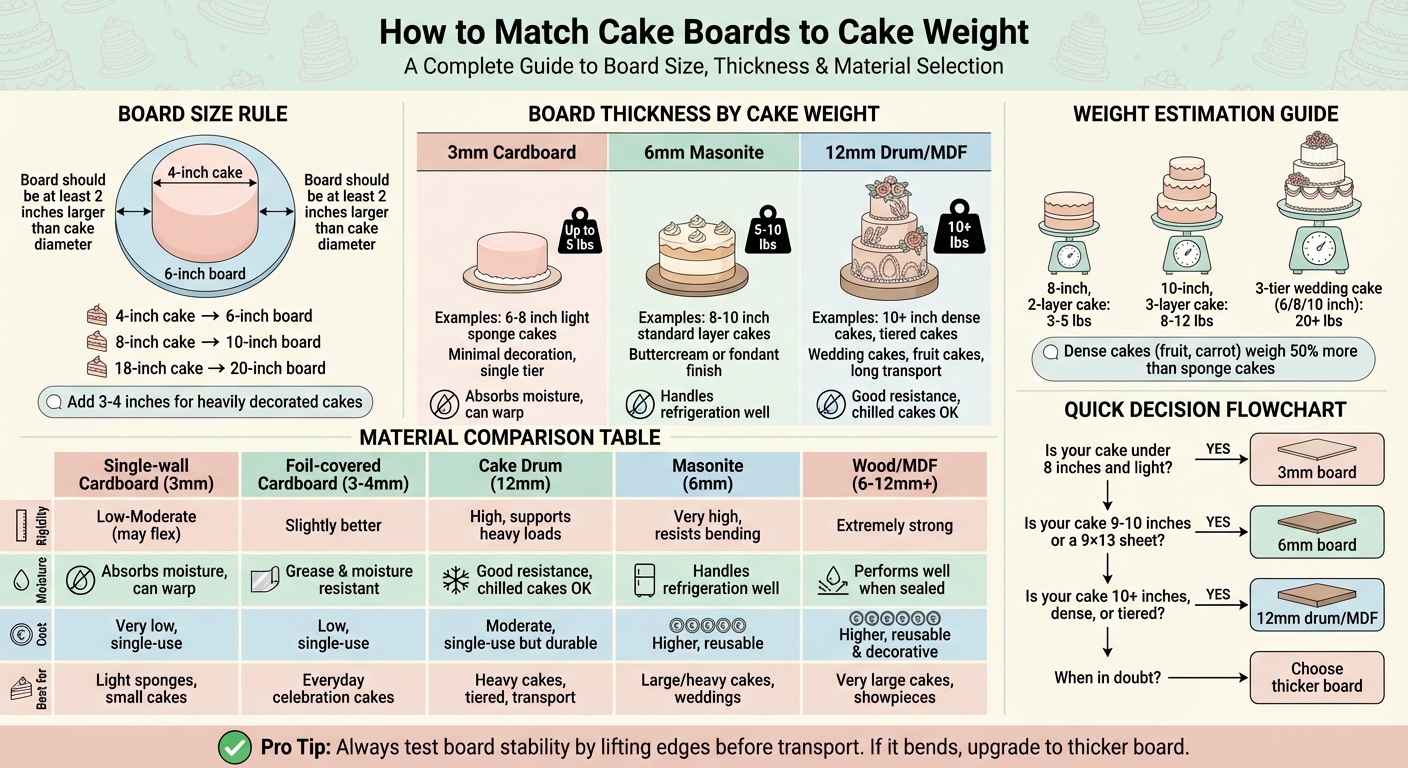
- Size: Use a board at least 2 inches larger than your cake's diameter for handling and decoration space.
- Thickness: Lightweight cakes work with 3 mm boards, while heavier or tiered cakes need 12 mm drums or MDF boards.
- Material: Cardboard works for light cakes, but denser or refrigerated cakes require grease-resistant options like foil-covered drums or sealed wood/MDF boards.
For example, an 8-inch, 2-layer sponge cake (about 3–5 lbs) fits a 3 mm board, while a 10-inch, 3-layer dense cake (8–12 lbs) needs a 12 mm drum. Always opt for a stronger board if unsure. Proper support ensures your cake stays intact and looks polished.
For professional-grade supplies, Los Angeles bakers trust Gloria's Cake & Candy Supplies, offering durable boards like their 12-inch Round Silver Cake Drum for $6.95.
Cake Board Selection Guide: Matching Board Thickness and Material to Cake Weight
Cake Decorating 101: Choosing the Right Base - Cake Boards vs. Cake Drums
How Cake Weight Affects Board Selection
Choosing the right board for your cake starts with understanding its weight. A light 6-inch sponge cake doesn’t need nearly as much support as a dense 10-inch fruitcake. The difference comes down to factors like ingredients, layers, fillings, and decorations - all of which add up. Let’s break down what contributes to a cake’s weight and how it impacts your board selection.
What Makes Cakes Heavy
The size and number of layers are the most obvious contributors to a cake’s weight. For instance, a 10-inch, 3-layer cake holds significantly more batter and filling than a 6-inch, 2-layer cake. On average, one 8-inch sponge layer weighs around 2–3 pounds, and stacking multiple layers increases the total weight accordingly.
The type of batter also plays a big role. Light sponge or chiffon cakes are airy and low in fat, making them relatively light. On the other hand, dense cakes like pound cakes, carrot cakes, or fruitcakes are packed with ingredients like butter, nuts, and fruit, which add considerable heft. For example, an 8-inch sponge cake might weigh 2–3 pounds, but an 8-inch fruitcake of the same height can easily weigh 4–6 pounds. For heavier cakes like fruitcakes, a 12 mm drum board is often recommended to ensure adequate support.
Don’t forget about fillings, frostings, and decorations. Thick layers of frosting, rich fillings, and elaborate decorations can all add substantial weight. Even structural elements like internal boards and dowels in tiered cakes contribute to the overall load. These factors not only determine the cake’s total weight but also influence how that weight is distributed.
How Weight Distributes in Different Cake Types
For single-tier cakes, the entire weight rests directly on the base board. It’s crucial that this board is sturdy enough to handle the load without bending, as any flexing could cause the cake to crack or shift during transport.
Tiered cakes distribute weight differently. In a properly supported tiered design, each tier sits on its own board, with dowels or columns providing vertical support to prevent the upper tiers from crushing the lower ones. However, the base board still carries the combined weight of all tiers, including fillings, decorations, and internal supports. For example, a 3-tier cake with a 6-inch top tier, an 8-inch middle tier, and a 10-inch bottom tier might weigh over 20 pounds. To handle this, bakers often use a 14-inch board made from a 12 mm drum. Tall, narrow cakes concentrate weight in a smaller area, making a rigid, non-flexing base even more essential.
How to Estimate Your Cake's Weight
For home bakers in the U.S., weighing your ingredients is the most reliable way to estimate a cake’s weight. Add up the weights of the batter, fillings, and frosting. If your recipe uses cups, convert those measurements into ounces or pounds using a kitchen scale. This will give you a good idea of the cake’s weight before it’s even baked.
As a general guide, an 8-inch, 2-layer cake typically weighs 3–5 pounds, while a 10-inch, 3-layer cake can range from 8 to 12 pounds. Dense cakes like carrot or fruitcake can weigh about 50% more than lighter cakes of the same size.
If you’re unsure, professional baking supply stores, such as Gloria's Cake & Candy Supplies in Los Angeles, can help you choose the right board thickness based on your cake’s size, tiers, and estimated weight. When in doubt, it’s always better to go with a thicker board than risk a collapse - extra support is never a bad idea.
Cake Board Materials and Their Uses
Types of Cake Board Materials
Picking the right material for your cake board is just as important as choosing the correct thickness. Together, these factors ensure your cake is properly supported.
Single-wall cardboard boards are thin (about 1/8 inch or 3 mm) and made from compressed paperboard or corrugated cardboard. These boards are typically covered with grease-resistant foil or paper to keep them food-safe. However, they’re not strong enough to handle heavy cakes on their own.
Masonite boards, which are thicker at 1/4 inch (6 mm), are made from compressed wood fibers. They offer much more rigidity compared to cardboard. Often wrapped in food-safe foil or fondant, these boards are reusable if properly covered and cleaned.
Cake drums are even thicker, at 1/2 inch (12 mm), and consist of layered corrugated cardboard wrapped in grease-resistant foil. They’re designed to handle heavy, dense, or multi-tier cakes, making them a favorite for professional bakers working on wedding cakes or other elaborate designs that require extra stability.
Wood and MDF boards provide the highest level of strength and come in thicknesses starting at 6 mm. These boards must be sealed or covered with food-safe materials before use. They’re reusable, decorative, and perfect for supporting very heavy or wide cakes, making them ideal for showpieces, large stacked cakes, or any scenario where both appearance and durability are crucial.
Comparing Board Materials
| Material | Thickness | Rigidity | Moisture Resistance | Cost & Reuse | Best For |
|---|---|---|---|---|---|
| Single-wall cardboard | ~3 mm | Low to moderate; may flex | Absorbs moisture; can warp | Very low cost; single-use | Light sponges, small single-tier cakes, internal tier boards |
| Foil-covered cardboard | ~3–4 mm | Slightly better than plain boards | Grease and moisture resistant | Low cost; single-use | Everyday celebration cakes of moderate weight |
| Cake drum | ~12 mm (1/2 in) | High rigidity; supports heavy loads | Good resistance; suitable for chilled cakes | Moderate cost; single-use but durable | Heavy dense cakes, tiered wedding cakes, long-distance transport |
| Masonite | ~6 mm | Very high rigidity; resists bending | Handles refrigeration well when protected | Higher cost; reusable | Bases for large/heavy cakes, wedding cakes, tall structures |
| Wood/MDF | 6 mm–12 mm+ | Extremely strong; supports very heavy cakes | Performs well when sealed | Higher cost; reusable and decorative | Display base for very large or stacked cakes; showpiece cakes |
Selecting the right board material means weighing its rigidity against its cost. Any flex in the board can lead to issues like cracked icing, bulging edges, or even internal support failure if the cake shifts. For example, single-wall cardboard is more likely to bend under the weight of larger or heavier cakes, such as those with fruit fillings or cheesecakes. In these cases, cake drums or masonite boards are a safer choice. For tall, narrow cakes or intricate designs with delicate sugar work, wood or MDF boards are a must.
Moisture resistance is another critical factor, especially for cakes stored in refrigerated environments.
Moisture and Refrigeration Effects
While rigidity is vital, moisture control is equally important for maintaining the board’s stability. The choice of board material directly affects how well it handles both weight and environmental conditions like condensation.
Plain cardboard is prone to warping when exposed to condensation, making it unsuitable for refrigerated cakes or those with soft fillings. For cakes that need to be chilled - like whipped cream-filled or drip cakes - foil-covered cake drums or sealed MDF/wood boards are better options. These materials maintain their structure even in moist environments. Avoid using plain cardboard for extended refrigeration or high-moisture fillings, as it can compromise the cake’s stability.
Foil-laminated boards and coated cardboard have grown in popularity, especially as bakers increasingly work on cakes that require refrigeration. The foil layer adds grease and moisture resistance, making these boards a better fit for chilled creations.
Wood and MDF boards, when properly sealed or covered, are excellent for refrigeration. They resist condensation, can be wiped clean, and are reusable. This makes them especially practical for bakeries that regularly produce refrigerated cakes, offering both durability and convenience for repeated use.
sbb-itb-529d1c3
How to Select the Right Board Thickness and Size
Step 1: Determine Your Cake Type and Structure
The first step in choosing the right board is understanding your cake's type and structure. For instance, a single-tier, light sponge cake under 6 inches can sit comfortably on a 3 mm board. However, taller cakes create more downward pressure, requiring stronger support. Dense cakes like fruit cakes, mud cakes, or pound cakes need thicker boards, even if their diameter is small, because of their concentrated weight. Sheet cakes - especially half-sheet or full-sheet sizes - are another story. Their wide, flat shape makes them prone to flexing when lifted, so they need sturdy drums or stacked boards for proper support.
Tiered cakes demand the most robust support. Each tier should have its own board, and the base tier requires a 12 mm drum or MDF board. This ensures stability and makes transportation easier.
Here are some considerations when selecting your board:
- Height and layers: Cakes taller than 5–6 inches need stronger support.
- Recipe density: Heavier cakes, like fruit or mud cakes, require thicker boards due to their weight.
- Transport distance: Long trips or frequent handling call for 12 mm drums or MDF boards, even for medium-sized cakes.
- Multiple factors: If your cake is dense, tall, tiered, or needs to travel far, always choose a drum or MDF board for safety.
Once you've accounted for the cake's type and structure, selecting the right board size becomes much simpler.
Step 2: Select the Correct Board Dimensions
The general rule is to use a board that's at least 2 inches larger than your cake's diameter. For example, a 4-inch cake needs a 6-inch board, while an 18-inch cake requires a 20-inch board. This extra space provides room for safe handling and clean edges.
For cakes that are heavier or heavily decorated, consider increasing the clearance to 3–4 inches. This allows room for fondant ruffles, floral arrangements, or intricate piping. For example, an 8-inch cake with elaborate decorations might work better on a 12-inch board.
Sheet cakes should follow a similar principle. Match the board to the pan size and add at least 1–2 inches on all sides for easy gripping. Large sheet cakes, like 12×18 inches or full sheets, need thicker or double-stacked boards to avoid sagging.
The same sizing principle applies to cakes of all shapes - round, square, hexagon, or custom designs. Simply measure the widest point of the cake and add at least 2 inches (or more for heavier or highly decorated cakes).
Step 3: Match Board Thickness to Cake Weight
After determining the size, the next step is to match the board's thickness to your cake's weight. Use these practical guidelines:
- A cooled, filled, and frosted cake up to 8 inches that can be lifted on a 3 mm board without bowing is fine with that thickness. If there's any flex, upgrade to 6 mm.
- Cakes between 9–10 inches or taller cakes that feel heavy when lifted, as well as 9×13 inch sheet cakes, should use a minimum of 6 mm boards.
- For fully decorated 10-inch dense cakes or 2-tier cakes (often weighing 10–20 lbs), choose a 12 mm drum or MDF board to prevent flexing and ensure stability.
Professional decorators often rely on 12 mm drums or wooden/MDF boards for safety and a polished finish. Here's a quick reference table for board thickness:
| Cake Type | Board Thickness | Notes |
|---|---|---|
| Light sponge (6–8 in) | 3 mm cardboard | Minimal decoration, single tier |
| Standard layer cake (8–10 in) | 6 mm masonite or foil-covered board | Buttercream or fondant finish |
| Heavy dense cake (10+ in) | 12 mm drum | Fruit cake, mud cake, or tall structures |
| Tiered or large sheet cakes | 12 mm drum or MDF | Wedding cakes, full-sheet cakes, long transport |
For cakes in humid or moist conditions, sealed boards are a better choice. When in doubt, always opt for thicker boards - it’s better to over-support a cake than risk it collapsing.
Tips for Handling and Transporting Cakes
How to Test Board Stability
Before you move your cake, it’s essential to make sure the board can handle the weight. Start with a quick test: lift the board by its edges. If it bends or feels flimsy, swap it out for a thicker, sturdier option. For multi-tier cakes, gently press along the edges of the top tier. If you notice any wobbling or shifting, take a moment to double-check your dowels and internal supports. Once you’re confident the board is solid, secure the cake to prevent any movement during transport.
Using Non-Slip Mats and Extra Supports
Even with a strong board, you’ll want to take extra steps to keep your cake safe during the journey. Start by anchoring the cake to its board with a small dab of frosting - it acts like glue to hold it in place. Then, place a non-slip mat between the board and the transport tray to stop any sliding. When loading the cake into your vehicle, set it on a flat, stable surface like the trunk or a sturdy cake box with proper supports. For buttercream cakes, chill them until the frosting is firm (but not frozen solid) to help them hold their shape. And remember, drive carefully - slow starts, stops, and turns are your best friends here.
Protecting Boards from Moisture and Grease
Buttercream and whipped cream cakes can leave greasy stains on cardboard boards, which might weaken them over time. To avoid this, use foil-lined or greaseproof boards, especially if the cake will be refrigerated or displayed for a long period. You can also wrap the edges of the board with foil, tape, or fondant ribbon to keep moisture from seeping in, particularly in humid conditions. A well-chosen board goes a long way, but keeping your cake cool during transport is equally important - especially in hot U.S. weather.
If you’re a local baker looking for top-notch supplies and expert advice, check out Gloria's Cake & Candy Supplies in Los Angeles. They offer in-person consultations, same-day pickup, and a wide range of quality tools to make sure your cakes are both stunning and secure. For more details, visit their website at https://gloriascakeandcandy.com.
Conclusion
Picking the right cake board is essential for keeping your cake safe during transport and ensuring it looks its best on display. For light sponge cakes, a 3 mm board will do the job, but for denser or more elaborately decorated cakes, you’ll need the sturdiness of a 12 mm board. Matching the board to your cake’s needs guarantees it stays intact, maintains a polished appearance, and gives you peace of mind from preparation to presentation.
For the best results, choose a board that’s at least 2 inches larger than your cake, and consider going even bigger for heavier or intricately decorated designs. Moisture-prone cakes are best paired with greaseproof or foil-covered boards to prevent any issues. This attention to detail ensures your cake travels safely and looks professional, a sentiment shared by seasoned bakers.
If you're in Los Angeles and looking for expert advice, check out Gloria's Cake & Candy Supplies. Since 1972, their team has been guiding bakers - whether hobbyists or professionals - in selecting the right tools and supplies. With same-day pickup, personalized consultations, and sturdy boards starting at just $6.95 for a 12-inch silver cake drum, they’ve got everything you need to keep your cakes secure and stunning.
FAQs
How do I select the right cake board for a multi-tiered cake?
When picking the perfect cake board for a multi-tiered cake, start with one that’s at least 2 inches larger in diameter than the bottom tier. This extra space helps frame the cake beautifully and provides stability. The board should also be 1/8 to 1/4 inch thick to handle the weight without bending. Don’t forget - each tier needs its own board to support its individual weight.
For larger or heavier cakes, materials like sturdy cardboard, foam core, or masonite are your best bet. These options prevent sagging or collapsing, keeping your cake secure during transport and display. Focus on durability and proper sizing to ensure your masterpiece stays intact and looks stunning.
What type of cake board works best in humid conditions?
In humid climates, metal, acrylic, or plastic cake boards are a smart choice. Unlike cardboard or foam, these materials stand up well to moisture, making them less prone to warping. They provide a solid, dependable base that keeps your cake stable and looking great, no matter the weather.
How do I determine my cake's weight to choose the right cake board?
To figure out your cake's weight, you have two options: weigh the completed cake using a kitchen scale or add up the weight of all the ingredients before baking, keeping in mind any moisture that evaporates during the process. Once you have the weight, pick a cake board that can handle the load. Pay attention to the material and thickness - thicker cardboard or wooden boards work best for heavier cakes.

