

High ratio shortening and pH balance are critical factors in baking that directly impact the texture, structure, and stability of your creations. Here's what you need to know:
-
High Ratio Shortening: A 100% fat vegetable shortening with added emulsifiers (e.g., mono- and di-glycerides) that allows recipes to hold more sugar and liquid. It produces moist, tender cakes and smooth icings.
- Substitutes butter with an 80:100 ratio (80g shortening = 100g butter).
- Ideal for high-sugar recipes, offering stability across temperature changes.
-
pH in Baking: The acidity or alkalinity of ingredients affects leavening, browning, gluten development, and spoilage prevention.
- Most baked goods fall between pH 3.5–8.0.
- Acidic ingredients like buttermilk (pH ~4.5) or lemon juice (pH ~2.5) can enhance flavor but require balancing with alkaline agents like baking soda.
- Interaction: High ratio shortening works best when pH is controlled, ensuring emulsifiers stabilize the mixture. Extreme pH levels can cause texture issues or flavor imbalances.
For better results:
- Coat flour with fat before adding acidic ingredients to protect structure.
- Balance acidic recipes with small amounts of baking soda to maintain optimal pH.
- Use tools like Sweetex Golden Flex shortening for professional-grade performance.
From our counter in Culver City
High ratio shortening is one of those ingredients that separates the people who bake once a year from the people who bake every week. We sell Sweetex Golden Flex by the pound, and we go through a lot of it — home bakers discover it, try it once, and never go back to butter-only frosting. If you’re making a wedding cake in July in Los Angeles, this is the stuff that keeps your buttercream from sliding off the tiers.
Properties of High Ratio Shortening
High ratio shortening stands out from standard shortening due to its 100% fat composition, containing no moisture at all. This pure fat structure eliminates water interference, allowing the fat to interact more effectively with other ingredients. What makes it even better are the added emulsifiers, typically mono- and di-glycerides with a Hydrophilic-Lipophilic Balance (HLB) between 2.8 and 3.5. These emulsifiers act as a bridge between water and oil, helping to stabilize mixtures, even when recipes include a lot of sugar and liquid. This unique composition makes high ratio shortening exceptional for creaming and emulsifying.
Creaming Ability and Emulsification
Thanks to its emulsifiers, high ratio shortening excels at incorporating air during the creaming process. When beaten with sugar, it traps air bubbles more efficiently than standard shortening, producing a fine crumb structure and increasing cake volume. For icing, it creates a smooth, less greasy consistency. Some brands, like Sweetex, are so concentrated that bakers can reduce the amount used - typically 2/3 cup to 1 cup of high ratio shortening replaces 1 cup of standard shortening in icing recipes.
Temperature Range and Functionality
High ratio shortening performs reliably across a wide range of temperatures, maintaining its structure without cracking in colder conditions or melting in warmer ones. It can withstand multiple freeze-thaw cycles without compromising icing quality, making it ideal for professional decorators who need their creations to survive transport and display. This stability is especially beneficial when recipes face pH variations, ensuring consistent texture and performance.
Moisture Retention and Texture
The emulsifiers in high ratio shortening allow it to hold more liquid and sugar than standard shortening. This results in cakes that are moist, tender, and have a smoother mouthfeel. Additionally, it slows down starch retrogradation - the process that makes baked goods go stale - extending shelf life significantly. This means baked goods stay fresh longer while retaining a soft, appealing texture. These qualities also affect how the shortening behaves under varying pH levels in baking.
sbb-itb-529d1c3
pH Basics for Bakers
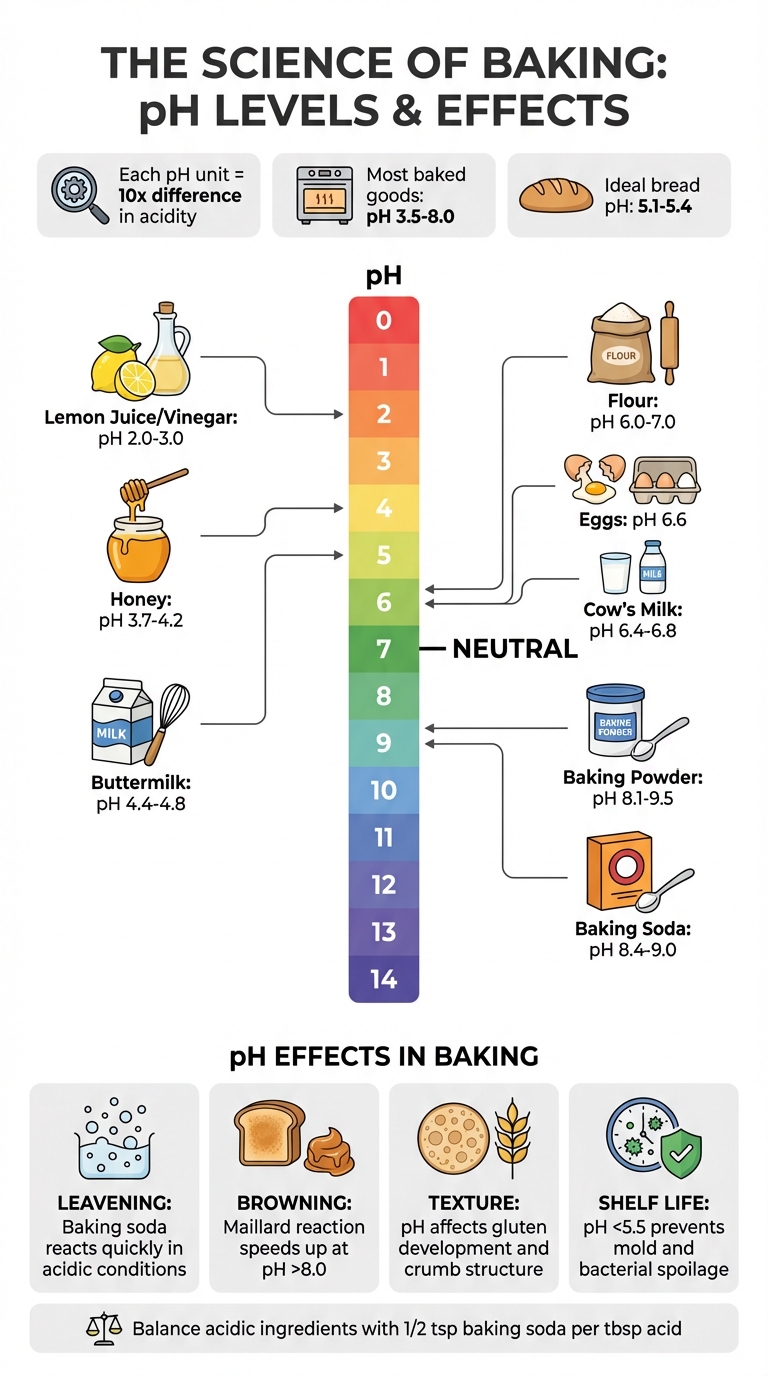
pH Levels of Common Baking Ingredients and Their Effects
pH, or "potential of hydrogen", measures how acidic or alkaline a substance is on a scale from 0 to 14. It’s a logarithmic scale, meaning each step represents a tenfold change in acidity. For example, a pH of 7 is neutral, while anything below 7 is acidic, and anything above 7 is alkaline (or basic). Even a small shift in pH - like 0.3 - can double the acid concentration.
In baking, pH plays a key role in everything from how leavening agents work to the texture and color of your final product. Richard Charpentier, Owner and CEO of Baking Innovation, highlights its importance:
The pH of bread dough is important to the quality of bread and can be affected by various factors, including the type of flour used, the temperature of the dough and the use of additives like salt and sugar.
Most baked goods fall within a pH range of 3.5 to 8.0. For example, white bread typically has a pH between 5.1 and 5.4, which helps create a desirable crumb structure. Now, let’s dive into how specific ingredients can alter pH.
Acidic and Basic Ingredients
Acidic ingredients lower the pH of a batter or dough by releasing hydrogen ions when dissolved. Common acidic ingredients include:
- Lemon juice (pH 2.0–3.0)
- Vinegar (pH 2.5–3.5)
- Buttermilk (pH 4.5–5.5)
- Yogurt, honey, and even chocolate
These ingredients not only add a tangy flavor but also enhance the perception of sweetness.
On the other hand, alkaline (or basic) ingredients increase pH by accepting hydrogen ions. Baking soda is a classic example, with a pH of about 9.0, while baking powder ranges from 8.1 to 9.5. When baking soda interacts with an acidic ingredient like buttermilk, it triggers a neutralization reaction that releases carbon dioxide gas, helping baked goods rise. Neutral ingredients, like flour, eggs, and cow’s milk, usually fall in the mid-range of the scale, with flour at pH 6.0–7.0, eggs around 6.6, and milk between 6.4 and 6.8.
How pH Affects Baking Results
The chemistry of baking is closely tied to pH. Leavening agents are especially sensitive: baking soda reacts quickly in acidic conditions, while alkaline environments slow its reaction. Yeast, too, thrives in slightly acidic conditions, with an ideal range of pH 4.0 to 6.0. For rye bread, maintaining a pH between 4.0 and 4.5 is essential to keep amylase activity in check - otherwise, the bread can develop a gummy or collapsed texture due to "starch attack".
pH also influences browning. The Maillard reaction, responsible for creating that golden crust, speeds up in alkaline conditions (pH >8.0). That’s why soda crackers (pH 7.2–8.0) brown more than sourdough bread (pH 3.8–4.6). Acidic batters, on the other hand, tend to produce lighter crusts. Too much baking soda can lead to over-browning and even leave a soapy aftertaste.
Beyond appearance, pH affects food safety. Keeping the pH below 5.5 helps prevent mold growth and reduces the risk of "bread rope", a spoilage caused by Bacillus bacteria. It also plays a role in the performance of emulsifiers in high ratio shortening, ensuring consistent results in baking. By understanding pH, bakers can fine-tune recipes for better outcomes.
How High Ratio Shortening Responds to pH Changes
Let’s take a closer look at how high ratio shortening’s emulsifiers handle changes in acidity within a recipe.
The emulsifiers in high ratio shortening, mainly mono- and di-glycerides, play a key role in stabilizing the air–water interface and reducing surface tension. This ensures the batter stays intact - even when acidic ingredients like honey or fruit acids are introduced.
The American Society of Baking highlights this benefit:
"Emulsifiers blended into a shortening assist in forming an emulsion allowing the baker to add more water to the cakes. In this way, it improves the eating qualities of the finished cake by retaining more moisture."
This moisture retention ties directly to pH control. In acidic batters, high ratio shortening emulsifiers maintain stability while the fat prevents gluten strands from binding too tightly. The result? A tender crumb. Additionally, the fat evenly distributes flavors throughout the emulsion, ensuring every bite tastes consistent.
Working with Acidic Ingredients
High ratio shortening thrives in acidic recipes because its emulsifiers remain effective even at lower pH levels. Ingredients like buttermilk, yogurt, or citrus juice can be added without causing separation, which is crucial for chemically leavened baked goods like muffins or layer cakes.
When working with highly acidic recipes, adding baking soda can help. It neutralizes the acid, releasing carbon dioxide for leavening and pushing the pH toward the ideal range of 5.1 to 5.4 - perfect for achieving a good crumb structure. However, extremely low pH levels can introduce unique challenges.
Problems with Low pH Levels
While high ratio shortening supports stability in many acidic conditions, extremely low pH can cause issues. For one, acidic batters can inhibit the Maillard reaction, which relies on a pH above 8.0 to create that golden-brown crust. As a result, cakes may look pale even when fully baked. Additionally, excess acidity can lead to a sharp, unpleasant taste, and over-correcting with too much alkaline can cause over-browning or a soapy aftertaste.
To fine-tune the pH, you can use specific acids like fumaric, malic, citric, or acetic acid to lower it. For balancing excess alkalinity, cream of tartar (potassium bitartrate) is a reliable option. The goal is to find the sweet spot where emulsifiers work effectively, browning happens naturally, and the flavors remain harmonious.
Adjusting Recipes for pH Balance
Fine-tuning recipes for pH balance ensures the structure and texture of baked goods while maximizing the performance of high ratio shortening. By carefully adjusting ingredient order and proportions, you can achieve optimal results.
Balancing Ingredients
When using high ratio shortening in recipes with acidic elements, protecting the flour proteins from acid damage is crucial. Summer Stone, a contributor to The Cake Blog, offers this insight:
It appears that when the flour has a chance to be coated with fat the acid has less effect on the cake.
This means you should mix acidic ingredients only after the flour has been coated with fat, such as shortening. To counteract acidity, add 1/2 teaspoon of baking soda per tablespoon of acidic ingredient. This adjustment balances the sourness and structural effects of the acid. Be cautious, though - too much baking soda can lead to a chemical aftertaste and excessive browning.
pH Levels of Common Ingredients
Knowing the pH levels of your ingredients can help you plan the order of mixing and determine the right leavening agents. Here's a quick guide:
| Ingredient | Typical pH Level | Baking Guidance |
|---|---|---|
| Lemon Juice / Vinegar | 2.0–3.0 | Add after flour to protect structure; neutralize with baking soda. |
| Honey | 3.7–4.2 | Highly acidic; may need a pinch of baking soda for balance. |
| Buttermilk | 4.4–4.8 | A common acid source; reacts with baking soda for leavening. |
| Cow's Milk | 6.4–6.8 | Nearly neutral; has minimal impact on shortening functionality. |
| Eggs | 6.6 | Adds structure, balancing shortening's tenderizing effect. |
| Baking Soda | 8.4 | Alkaline agent that neutralizes acids and enhances browning. |
Keep in mind that each unit change in pH represents a tenfold difference in acidity. For example, moving from pH 7 to pH 4 increases acidity by 1,000 times. Use these values to make precise adjustments in your recipes.
Recipe Applications
When working with recipes like lemon cake, pH-aware techniques can make a huge difference. Begin by creaming high ratio shortening with sugar and eggs. Next, mix in the flour to coat it thoroughly before adding acidic ingredients like lemon juice. This method helps protect the cake's structure while preserving the emulsification properties of the shortening.
Acidic batters tend to brown less during baking, so check for doneness earlier than usual. Use a toothpick test rather than relying only on color to avoid overbaking. These steps ensure a balanced, tender, and perfectly baked result.
What bakers ask us at the counter
- “Can I use Crisco instead?” — Regular Crisco works in a pinch, but it doesn’t have the emulsifiers that let you load up on sugar. Your frosting will taste greasier and break down faster in heat. If the recipe says high ratio, it means high ratio.
- “How much do I need for a tiered cake?” — Figure about a pound per tier for crumb coat plus finish coat. A three-tier wedding cake: grab 4 lbs to be safe. At $7/lb, it’s cheaper than ruining a batch.
- “Does it go bad?” — Sealed, room temp, away from sunlight: 6+ months easy. We’ve had bakers come back a year later with the same tub and it’s fine. Check our storage guide for the details.
- “My buttercream is grainy — what happened?” — Almost always a temperature issue. Shortening and sugar both need to be room temp. If either one was cold, the sugar can’t dissolve into the fat properly. See our buttercream troubleshooting guide.
High Ratio Shortening at Gloria's Cake & Candy Supplies
Why Shop at Gloria's
Since 1972, Gloria's Cake & Candy Supplies has been the go-to shop for professional-grade baking ingredients in Los Angeles, Culver City, and the Westside. Located in Culver City, the store offers not just top-tier products but also personalized, in-person consultations. Their experienced staff can guide you through the finer points of using high ratio shortening - a pure fat formula that avoids adding extra water, which could otherwise disrupt recipes, especially those that are pH-sensitive like lemon cakes or buttermilk batters.
Need your supplies quickly? Most orders are ready for same-day pickup within 24 hours. On top of that, the staff provides tailored advice to help you adjust recipes for the best results when working with high ratio shortening. It’s this combination of expertise and convenience that keeps bakers coming back.
Beyond consultations, Gloria's also carries a carefully selected range of premium baking products to meet every need.
Products and Services
One standout product at Gloria’s is Sweetex Golden Flex, a professional-grade, non-PHO, soybean-based high ratio shortening priced at $7.00 per pound. This shortening is perfect for high ratio cakes, delivering moist textures and creamy white icings while containing zero grams of trans fat per serving. It’s specifically designed to maintain ingredient harmony and pH balance, making it a favorite for bakers aiming for consistent, high-quality results.
Customer Olivia M. from Del Rey shared her experience:
I tried this on a whim, and now it's all I use. My customers keep raving about the texture and flavor.
But Gloria's doesn’t stop at shortening. They also stock Mercken's chocolate wafers and host cake decorating classes that teach hands-on techniques, including how to balance pH and manage ingredient interactions.
You can visit Gloria’s at 11117 Washington Boulevard, Culver City, CA 90232. The store is open from 10:00 AM to 6:00 PM, Tuesday through Saturday. Whether you’re a professional baker or a passionate hobbyist, Gloria’s has everything you need to take your creations to the next level.
Conclusion
Understanding how high ratio shortening works alongside pH balance brings precision to baking. High ratio shortening, made up of 100% fat with added emulsifiers, allows batters to hold more sugar and liquid compared to standard shortening. However, these emulsifiers only perform effectively when the pH is within the right range. If the pH is too acidic or too alkaline, the emulsion can break, leavening may fail, and textures can become compromised.
Most baked goods fall into a pH range of 3.5 to 8.0, and even small changes in pH can significantly increase acidity. For example, white bread achieves its ideal crumb texture when the pH is kept between 5.1 and 5.4. When working with high ratio shortening in recipes like layer cakes or buttercream, maintaining this balance ensures a stable emulsion and a tender texture.
pH balance doesn’t just influence structure; it also affects appearance and shelf life. For instance, Maillard browning speeds up when the pH exceeds 8.0, while adding acids like cream of tartar can help control over-browning. Additionally, keeping the pH below 5.5 can prevent spoilage caused by Bacillus spp. bacteria, which can lead to "rope" formation. Combined with the moisture-retaining properties of high ratio shortening, pH-balanced recipes stay fresh for longer periods.
While high ratio shortening itself doesn’t change pH, its ability to emulsify depends entirely on maintaining proper pH levels. Whether you’re fine-tuning acids to enhance leavening or balancing alkaline ingredients, these small adjustments ensure consistently great results every time.
FAQs
When should I use high ratio shortening instead of butter?
When you need stability, moisture retention, and resistance to temperature changes, high-ratio shortening is your go-to. It’s perfect for creating smooth, sturdy frostings like buttercream and holds up well in warmer conditions, as it resists melting and cracking. Unlike butter, high-ratio shortening can absorb more sugar and liquids, resulting in cakes that are sweeter, moister, and less greasy. While butter is often chosen for its rich flavor, it doesn’t offer the same stability or performance as high-ratio shortening.
How do I know if my batter is too acidic or too alkaline?
You can measure your batter's pH with either pH paper or a pH meter. A reading under 7 indicates acidity, while anything above 7 signals alkalinity. Acidic batters might result in paler baked goods and can impact gluten development, whereas alkaline batters could cause over-browning or alter the texture. To adjust the pH, you can add acidic ingredients like lemon juice or alkaline ones like baking soda to find the right balance.
What’s the safest way to add baking soda to an acidic recipe?
The best way to incorporate baking soda into an acidic recipe is to combine it well with the other dry ingredients before introducing any liquids. This method guarantees even distribution, allowing the baking soda to react properly with the acid. The result? The right texture and rise for your baked treats.
Shop Baking Essentials at Gloria's
We carry high ratio shortening, meringue powder, and everything else mentioned in this guide. In stock on the shelf — no waiting for shipping.
- Edible Decorations & Sprinkles
- Piping Tips for Frosting Work
- Custom Edible Image Printing
- Cake Decorating Classes
11117 Washington Blvd, Culver City • Tue-Sat 10am-6pm • (323) 289-8807
Related Blog Posts
- The Complete Guide to High Ratio Shortening: Why Bakers Choose It Over Butter
- Heat-Stable Frosting for LA's Warm Climate: Why Bakers Trust High Ratio Shortening
- Professional Cake Decorating with High Ratio Shortening: Advanced Techniques
- High Ratio Shortening vs. Butter in Frosting: A Side-by-Side Comparison

