

When it comes to confectionery coatings, Mercken's wafers stand out for their smooth melting process, consistent flavor, and ease of use. Unlike traditional chocolate, these coatings don’t require tempering, making them a practical choice for both home bakers and professionals. Whether you're dipping strawberries or decorating cake pops, Mercken's delivers reliable results.
Here’s how Mercken's compares to other popular options:
- Melting: Small wafers melt evenly and quickly.
- Texture: Smooth, fluid coating with no dripping.
- Flavor: Rich and consistent taste.
- Price: Premium at $8.99–$9.50 per pound.
Quick Comparison:
| Feature | Mercken's | Wilton Candy Melts | Make N' Mold | Almond Bark |
|---|---|---|---|---|
| Melting Speed | Fast | Slow | Moderate | Varies |
| Texture | Smooth, fluid | Thick | Thick, manageable | May need thinning |
| Flavor | Rich | Standard vanilla | Good | Basic sweetness |
| Price | Premium | Budget-friendly | Moderate | Affordable |
For best results, melt Mercken's wafers at 115°F–120°F and work at 98°F–102°F. Use Paramount Crystals to adjust thickness if needed and avoid water-based colors to prevent texture issues. Perfect for creating professional-quality treats with minimal effort.
CHEAPEST Vs. MOST EXPENSIVE CHOCOLATE *Honest Review | Which Chocolate Brand is the Best For Treats?
sbb-itb-529d1c3
What Sets Mercken's Wafers Apart
Mercken's wafers stand out for their exceptional melting performance, smooth texture, and consistent flavor, making them a favorite among both home bakers and professionals.
These small, uniform wafers - often called "little gems" - melt evenly at temperatures between 115°F and 120°F, preventing issues like hot spots or burning during use. Thanks to their no-tempering formula, which uses vegetable oil instead of cocoa butter, there's no need for complex temperature management. They remain workable at an ideal range of 98°F to 102°F, giving plenty of time for dipping, drizzling, or molding.
Flavor consistency is another hallmark of Mercken's wafers. Their long-standing recipes ensure that every batch delivers the same reliable milk chocolate taste, perfect for repeat customers. The product line includes milk (Cocoa Lite), dark (Cocoa Dark), white, super white, vanilla, and butterscotch varieties. Additionally, the Rainbow™ line offers pre-colored wafers, eliminating the hassle of manual tinting.
Beyond flavor, these wafers provide a smooth texture and a glossy finish that sets beautifully without issues like blooming or seizing. Feedback from users highlights their quality - Julia M. from Manhattan Beach shared, "Absolutely love these wafers! They melt perfectly and taste amazing." Even beginners can achieve professional-looking results, which has made these wafers a go-to choice for many.
To maintain their quality, store the wafers at 65°F–68°F with humidity levels below 50%. Pricing starts at $8.99 per pound for standard flavors, with the super white variety priced at $9.50 per pound. Bulk buyers can opt for 45-pound cases, offering great value for professional-grade results.
Mercken's Wafers vs. Other Coating Options
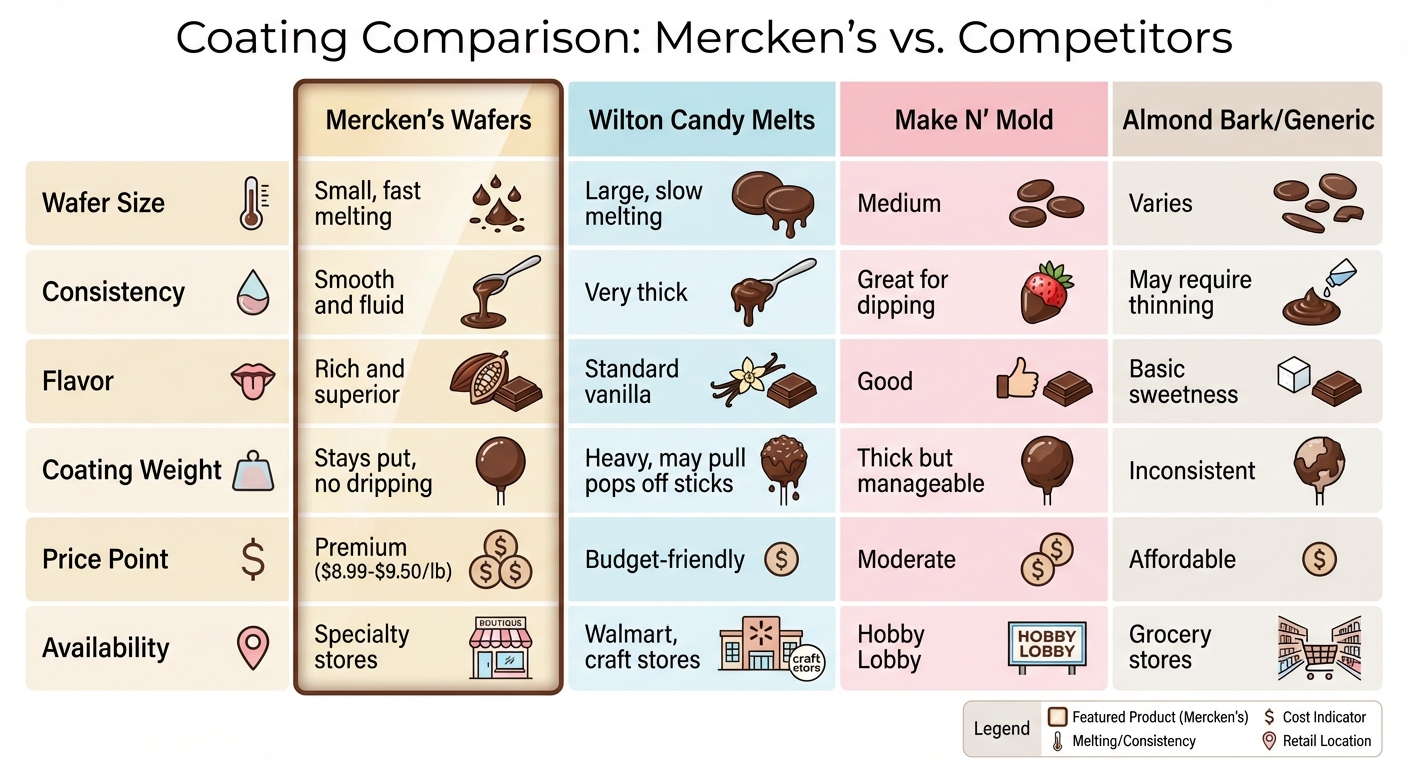
Mercken's Wafers vs Other Coating Options Comparison Chart
Mercken's wafers are celebrated for their reliable melting performance and consistent flavor. But how do they stack up against other popular coating options? Comparing these products can help bakers save time and achieve the best results.
Wafer size plays a major role in melting speed and ease of use. Mercken's small wafers melt quickly and evenly, making them a standout choice. In contrast, Wilton Candy Melts feature larger wafers that take longer to melt, which can slow down the process.
Consistency is another critical factor when it comes to coatings. Wilton's formulation creates a very thick coating, which can be so heavy it pulls cake pops off their sticks during dipping. Make N' Mold wafers, while excellent for dipping, result in a thicker finish. Mercken's strikes a balance with a smooth, fluid texture that adheres perfectly without dripping or leaving unwanted "tails" behind.
Flavor is where Mercken's truly shines. Baker Susanne Queck has praised its richer, superior taste. By comparison, generic almond bark offers a simple, sweet flavor that lacks the depth of Mercken's.
Here's a quick comparison of key features:
| Feature | Mercken's | Wilton Candy Melts | Make N' Mold | Almond Bark/Generic |
|---|---|---|---|---|
| Wafer Size | Small, fast melting | Large, slow melting | Medium | Varies |
| Consistency | Smooth and fluid | Very thick | Great for dipping | May require thinning |
| Flavor | Rich and superior | Standard vanilla | Good | Basic sweetness |
| Coating Weight | Stays put, no dripping | Heavy, may pull pops off sticks | Thick but manageable | Inconsistent |
| Price Point | Premium | Budget-friendly | Moderate | Affordable |
| Availability | Specialty stores | Walmart, craft stores | Hobby Lobby | Grocery stores |
For bakers aiming for professional results, Gloria's Cake & Candy Supplies offers Mercken's wafers along with a wide selection of other baking essentials. Whether you're crafting cake pops or coating treats, Mercken's delivers the performance and flavor you need.
How to Use Mercken's Wafers for Best Results
Mercken's wafers are known for their smooth melting properties, but getting the best results requires a bit of care. Start by melting the wafers between 115°F and 120°F. Once melted, let the coating cool down to a working temperature of 98°F to 102°F. Be cautious - heating above 120°F can permanently damage the coating’s texture and quality.
For small batches, the microwave method works well. Heat the wafers in 30-second intervals at 50% power, stirring after each round to ensure an even, smooth consistency. If you're working with larger quantities, a double boiler is a better choice. Keep the water simmering gently, and make sure the bowl holding the wafers doesn’t touch the water or get exposed to steam.
If the coating becomes too thick due to moisture, you can thin it out using Paramount Crystals (Palm Kernel Oil flakes). Add the crystals one teaspoon at a time, following the recommended ratio of 1/4 ounce (7 grams) per 1 pound (16 ounces) of wafers. Avoid adding extra heat to thin the mixture; this could lead to burning.
When adding color, stick to oil-based candy colors. Water-based food coloring can ruin the texture, causing the coating to seize. Add the color in small amounts, mixing thoroughly until you reach your desired shade.
Once you've coated your treats, let them set in a well-ventilated area at a temperature between 45°F and 65°F. This helps achieve a glossy finish and proper crystallization. Avoid refrigerating or freezing the finished products, as condensation can damage the coating. For supplies like Mercken's wafers, Paramount Crystals, and oil-based candy colors, check out Gloria's Cake & Candy Supplies for professional-grade options.
Final Thoughts
Mercken's wafers stand out for their flavor, user-friendly nature, and reliable professional results. Their creamy taste and no-tempering formula make them a favorite for both beginners and seasoned decorators. As Merckens puts it: "No tempering is necessary. Just melt and create!".
Beyond their flavor, these wafers deliver a smooth, glossy finish whether you're molding, dipping, or drizzling. Thanks to their forgiving working range of 98°F–102°F, they outperform temper-sensitive chocolates, making them a go-to choice for home bakers and professionals alike.
With over a century of history, Mercken's wafers have become synonymous with quality and consistency.
For those in the Los Angeles area, Gloria's Cake & Candy Supplies in Culver City offers Mercken's wafers at $9.25–$9.50 per pound. Orders are typically ready within 24 hours, making it a convenient option for local bakers.
FAQs
Are Mercken’s wafers real chocolate?
Mercken's wafers aren't classified as real chocolate. Instead, they fall under the category of chocolate compounds because they use vegetable oil in place of cocoa butter. This substitution makes them much simpler to melt and handle, making them a favorite for baking and candy-making projects.
Why does my coating get thick or grainy?
If your coating overheats, cools down too fast, or the melting temperature isn’t kept steady, it can turn thick or grainy. These problems can also lead to texture changes or fat bloom. To prevent this, melt the coating slowly over low heat, stirring regularly to maintain a smooth and even consistency.
How can I keep the finish glossy without refrigerating?
To keep chocolate looking glossy without refrigeration, it's important to melt and cool it at the right temperatures. Make sure it stays completely dry to avoid any water contact, which can ruin the texture. Handle the chocolate gently to prevent bloom - a harmless effect that dulls the shine but doesn’t impact the taste or safety.
Shop Merckens & Chocolate Supplies
Merckens wafers, coating chocolate, and chocolate molds — all in stock at Gloria's.
Shop at Gloria's11117 Washington Blvd, Culver City • Tue-Sat 10am-6pm • (323) 289-8807

