

In 2026, cake decorating is all about blending visual appeal with shareable moments. Social media trends and new tools are driving bakers to push boundaries in design, flavor, and interactivity. Here's what to expect:
- Retro Revival: Lambeth piping and vintage aesthetics are making a strong comeback, inspired by the opulence of the '70s and '80s.
- Interactive Cakes: Burn-away layers, oozing centers, and theatrical cutting moments are turning cakes into experiences.
- Global Flavors: Ingredients like ube, saffron, and gulab jamun are introducing bold flavors to desserts.
- Design Extremes: Minimalist cakes with clean finishes contrast with maximalist designs full of bold textures and intricate details.
- Eco-Friendly Trends: Wafer paper, isomalt sculptures, and edible botanicals are replacing non-biodegradable decorations.
- Tech Tools: Edible ink printers and automated frosting machines are making custom designs faster and more precise.
- Personalized Messages: Cakes now tell stories with custom inscriptions and emotional themes.
- Botanical Accents: Vegetal flavors and edible flowers are transforming cakes into garden-inspired art.
- Playful Themes: Bold, whimsical designs are dominating social media feeds, celebrating individuality.
Los Angeles remains a hotspot, with bakers combining nostalgic techniques, cultural influences, and cutting-edge tools to create cakes that are as much about storytelling as they are about taste.
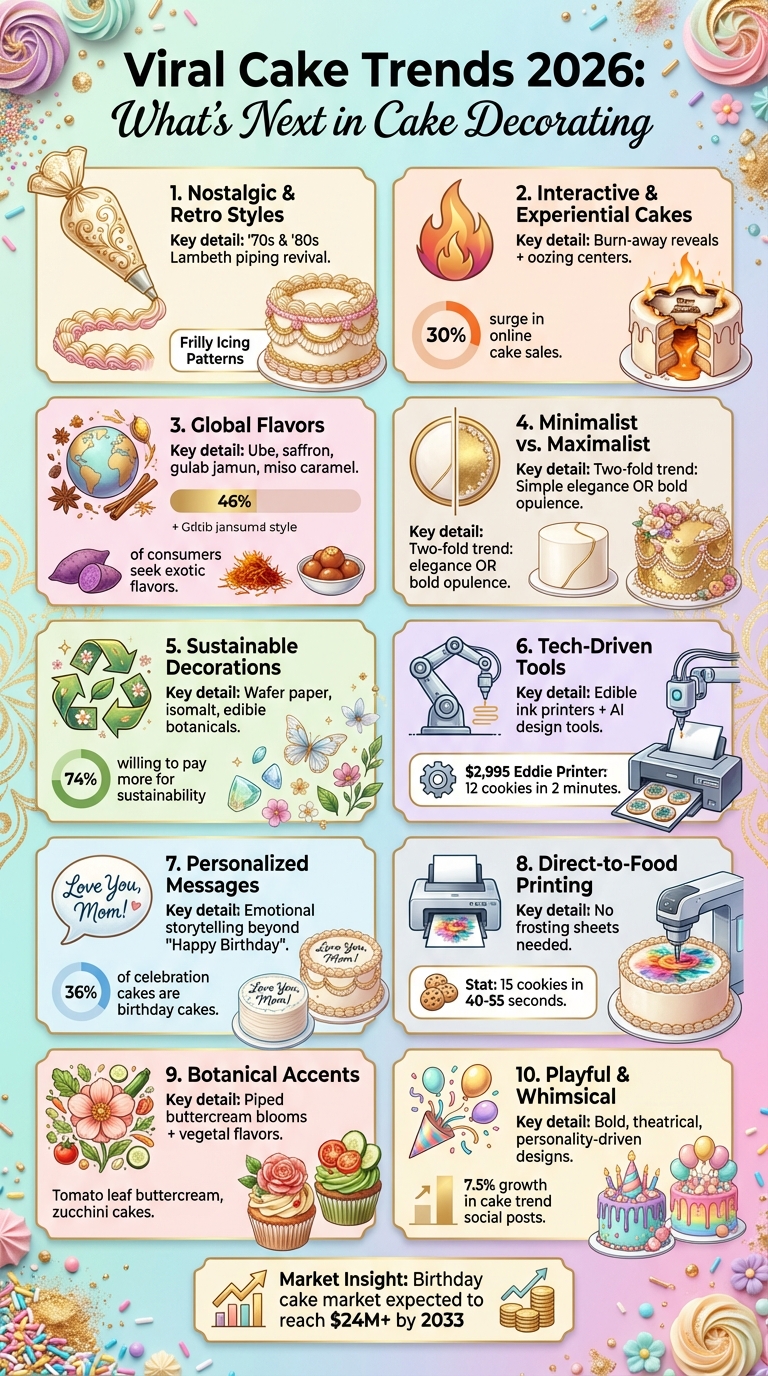
Top 10 Viral Cake Trends for 2026: A Visual Guide
1. Nostalgic and Retro Styles
The Return of '80s Opulence and Lambeth Piping
In Los Angeles, bakers are diving back into the lavish aesthetics of the 1970s and '80s, drawing inspiration from the era's cake artistry. At the center of this revival is Lambeth piping - a detailed technique that layers thick, frilly icing with ornate swags and intricate embellishments, turning cakes into true works of art.
But it’s not just about the piping. Many bakers are incorporating vintage accessories like pillars, angels, fountains, and swans into their designs. Ali Gala, founder of Disco Sugar, explains:
"Couples are looking to incorporate collectible vintage accessories like pillars, angels, fountains and swans into their cake designs, inspired by their parents' wedding albums and 1970s and 1980s Wilton cake decorating magazines".
Noelle Blizzard of New June also highlights the growing preference for this "Vintage Wilton" look, where couples are leaning into a fully retro aesthetic rather than sticking to a more understated, classic style.
This nostalgic trend brings back buttercream swags, ruffled-tulle heart toppers, and old-school couple figurines. Modern updates include dusty blue frosting paired with white piping and bold red cherries, or sleek all-white monochrome designs. TikTok has helped popularize heart-shaped cakes adorned with heavy Lambeth-style piping, making them a social media sensation.
Rebecca Pham of Little Sister Cake Shop sees no sign of this trend slowing down:
"The vintage/Lambeth-style cakes have still been on trend and popular for 2026 couples, and we don't think they're going anywhere soon".
Blending nostalgia with a modern flair, home bakers can get in on the action too. Using tools like the 789 basketweave piping tip for "squiggly" vintage-style designs and stucco-finish buttercream, they can create cakes that feel both personal and timeless. These designs strike a balance between looking lovingly homemade and impressively detailed, capturing the charm of family traditions while thriving in today’s social media spotlight. It's a trend that’s redefining retro cake artistry in fresh and exciting ways.
2. Interactive and Experiential Cakes
Burn-Away Reveals and Theatrical Cutting Moments
Cakes are no longer just desserts - they're performances. One of the hottest trends for 2026 is the burn-away cake, where a thin wafer or rice paper layer is set aflame to reveal a hidden image or message underneath. This TikTok-fueled phenomenon has become a go-to for gender reveals, anniversaries, and corporate events. In fact, online birthday cake sales have seen a surge of over 30% in the past year.
Reshmi Bennett, founder of Anges de Sucre, sums it up perfectly:
"Cakes with theatrics? Always a yes".
The dramatic moment when the flame unveils the surprise has become a must-capture event for guests, making these cakes a viral hit. But the drama doesn't stop there.
Bakers are also creating cakes with oozing centers that spill out when sliced - imagine miso caramel or fruit coulis flowing onto the plate. Jacqui Passmore from Dawn Foods highlights this trend:
"Cakes which have a personalised, visual or interactive element – indulgent 'oozing' centres or 'extra' toppings and fillings for example are perfect matches for this trend".
The visual impact of these designs is unforgettable, turning every slice into a moment of indulgence. And the classic cake-cutting tradition? That's getting a makeover too.
Daniel Colonel, a pastry chef based in New York, notes:
"Beyond the design, the cake-cutting moment itself is evolving into more of an experience. I've seen couples get involved in finishing the decor on their cake or having the cake wheeled right onto the dance floor so the celebration around it feels interactive and fun".
Some couples are even taking it a step further with "cake parades", where the wedding party delivers slices to guests with music and choreography.
To meet these demands, bakers are designing cakes that are as much about the reveal as they are about taste. Whether it's burn-away layers, cascading centers, or illusion-inspired designs, these interactive features are creating moments worth sharing. With one in three consumers now making food purchases directly through social media in 2024, these show-stopping cakes aren't just fun - they're a savvy way to grow a business.
3. Global Flavors and Cross-Cultural Aesthetics
Mithai-Inspired Cakes & South Asian Flavors
Traditional Indian sweets are getting a modern makeover, creating a buzz in the baking world. Think gulab jamun cheesecakes, cardamom-saffron layer cakes, and barfi-inspired trifles - all bringing the bold, rich flavors of mithai to mainstream bakeries. This trend doesn’t just satisfy a sweet tooth; it’s a celebration of heritage and creativity, perfectly aligning with the growing popularity of experiential cake designs.
Reshmi Bennett, Founder of Anges de Sucre, highlights the cultural significance driving this movement:
"As Diwali celebrations become more commercialised, South Asian dessert flavours are crossing over into the mainstream... Cultural pride is strongly correlated to culinary inspiration."
This blending of traditions is paving the way for a global flavor revolution.
Beyond South Asia, ingredients from the Middle East like pistachio, tahini, and saffron are taking center stage in sophisticated cake designs. Over in Southeast Asia, flavors such as ube and pandan are stealing the spotlight, thanks to their vibrant colors that light up social media feeds. Filipino ube, in particular, is popping up in everything from Swiss rolls to doughnuts and layered cakes, creating visually stunning and shareable desserts.
As global palates expand, Jacqui Passmore from Dawn Foods notes:
"Flavour-wise, think anywhere from Italy to Tokyo with consumers willing to get their taste passports out to travel far and wide."
With 46% of consumers seeking out exotic flavor combinations, bakers are pushing boundaries with creations like miso caramel and yuzu-infused buttercream. The cake scene for 2026 is shaping up to be a flavorful adventure, blending respect for cultural traditions with bold new ideas.
4. Minimalist and Maximalist Designs
The Great Divide: Choosing Between "Less is More" and "More is More"
Cake trends for 2026 have split into two distinct camps, each making a bold statement in its own way. On one end, minimalist designs focus on simplicity and elegance, showcasing semi-naked finishes, smooth mirror glazes, and clean lines that highlight the cake's structure. On the other end, maximalist creations go all out, featuring intricate piping, metallic accents, and elaborate decor that often extends beyond the cake itself - think trailing ribbons, candles, and mounds of fresh fruit.
Natalie Douglas, Director of Sponge Cakes, perfectly sums up this divide:
"Visually the trends are two-fold. On one side, there's natural and artisan decoration with buttercream swooshes, semi-naked finishes... On the other, the focus is nostalgic fun: sprinkles, retro piping, bold colours."
Each style serves a different purpose and audience. Maximalist designs thrive in rustic settings and dominate social media feeds, especially on platforms like TikTok and Instagram. Their theatrical elements - like burn-away layers or hyper-textured piping - are made for viral moments. Meanwhile, minimalist cakes, with their understated charm, fit seamlessly into modern, natural settings.
Budget plays a big role in choosing between the two. Minimalist cakes, such as single-tier ovals, are often more affordable, while maximalist designs, with features like cascading handmade sugar flowers, can significantly increase costs.
For bakers in Los Angeles, having the right tools is essential. Smooth fondant and top-tier buttercream are must-haves for achieving flawless minimalist finishes. Maximalist designs, on the other hand, require specialized piping tips, edible metallics, and other unique materials. Whether you prefer the quiet sophistication of minimalist cakes or the playful opulence of maximalist creations, fully embracing your chosen style is key to creating cakes that not only look stunning but also generate buzz online.
5. Sustainable and Eco-Friendly Decorations
From Wafer Paper to Botanical Accents: The Zero-Waste Revolution
Sustainability has taken center stage in cake decorating, with bakers swapping out plastic for edible and biodegradable materials. Wafer paper, made from potato starch, is now a go-to for creating delicate, airy ruffles and flowers that completely dissolve. Meanwhile, isomalt sculptures - crafted from a sugar substitute - offer stunning, glass-like designs that are entirely edible. This trend blends artistry with a zero-waste approach, redefining how cakes are adorned.
Edible botanicals are also stepping into the spotlight. Instead of traditional non-edible decorations, bakers are opting for piped buttercream flowers and dried blooms like bunny tails or palm spears. Marie Soliday, the Owner of Confectionery Designs, highlights the practical benefits of sugar flowers:
"Sugar flowers aren't limited by the seasons, so you can have peonies, roses or any favorite flower on your cake no matter the time of year".
Fresh produce is another exciting addition to the eco-friendly toolkit. Imagine sugar-coated pears, grapes, and citrus fruits arranged in whimsical "cake meadows", or even vegetables like artichokes and ruffled cabbage adding bold, sculptural textures. These choices not only reduce waste but also bring a natural, artistic flair to cake designs.
The numbers back up this shift. A whopping 74% of consumers are willing to pay more for sustainable packaging. Veganism, too, has seen a dramatic rise - quadrupling in the UK between 2014 and 2019 to reach around 600,000 people. These trends have inspired bakers to experiment with plant-based alternatives like aquafaba and flax seeds for vegan meringues and structural elements. Reshmi Bennett underscores the growing focus on ethical sourcing:
"Sustainability concerns are increasingly affecting sourcing choices - expect more conversation about palm oil, cacao ethics, and packaging".
For bakers in Los Angeles and beyond, there are practical steps to embrace this eco-friendly movement: wrap dried flower stems in floral tape or dip them in chocolate for food safety, sugar-coat fresh produce for a sparkling effect, and incorporate vintage accessories for a sustainable yet sentimental touch.
6. Tech-Driven Cake Decorating Tools
From AI Vision to Direct-Print Magic: The Digital Bakery Revolution
Technology is turning cake decorating into a precise and efficient craft. Take the Eddie Edible Ink Printer, for example. This $2,995 machine uses food-grade edible ink to print directly onto cookies, macarons, and cakes - no frosting sheets required. It can whip out a full-color cookie in just 10 seconds or 12 cookies in about 2 minutes, with an ink cost of only $0.06 per 3-inch cookie. Tools like this are redefining how bakers approach decoration, paving the way for even more automation.
Then there are automated frosting machines, which take efficiency to the next level. These machines, equipped with advanced sensors and vision technology, analyze the unique shape of each treat to determine the exact placement and amount of royal icing. For instance, the FreddieView system can map out intricate designs automatically, eliminating the need for manual adjustments. With a speed of one cookie per minute, these machines can pipe and flood about three dozen 3.25-inch cookies in an hour.
Local bakeries are already seeing the benefits. At the Mall of America, Baking Betty's uses the Eddie printer to produce custom corporate logo cookies, cutting down production time while meeting strict NSF food safety standards. Similarly, Miss Macaron in Ontario has scaled up its custom orders by printing high-definition designs directly onto fragile macaron shells, all without damaging them. Adding to this, AI-powered design tools are helping bakers create intricate visual concepts and unique flavor pairings, which can then be sent straight to printers for production.
These advancements are not just about speed - they're about versatility, too. Professional food printers can produce vibrant images on 15 cookies in under a minute and can handle items up to 6.7 inches tall, including multi-layered cakes and donuts. For bakers in competitive markets like Los Angeles, these tools offer a way to deliver personalized, high-quality designs on a large scale, all while keeping their creative edge intact.
sbb-itb-529d1c3
7. Personalized and Message-Driven Cakes
From "Happy Birthday" to Emotional Storytelling
Gone are the days when a simple "Happy Birthday" written in icing was enough. Today, personalized cakes are all about capturing emotions and telling stories. Bakers are moving beyond generic greetings, opting for messages like "thinking of you", "well done", or "girls' night in" to mark special but often overlooked moments. These cakes aren't just desserts - they're reflections of the customers' lives and stories.
This trend has turned personalized messaging into an art form, making every cake feel like a one-of-a-kind creation. Birthday cakes alone now account for 36% of all celebration cake sales, and online orders for these unique creations have jumped by over 30% in the past year. The numbers back up the impact: the birthday cake market, valued at $16.17 million in 2025, is expected to surpass $24 million by 2033. Clearly, personalization isn't just an extra touch - it's a major driver of sales.
One standout innovation is the use of burn-away rice-paper toppers, which can reveal hidden messages, adding an extra layer of surprise and meaning to the cake.
In Los Angeles, bakers are combining traditional calligraphy with cutting-edge edible printing to create truly tailored designs. Handwritten notes on fondant meet high-tech food printers that can reproduce intricate logos or photos in seconds. The focus is on making the message the star of the show - with clean, minimalist designs and bold lettering that look stunning both in person and on social media.
8. Edible Printing and Photo Cakes
Direct-to-Food Technology Changes the Game
Edible printing is taking a leap forward in 2026 with the rise of direct-to-food (DTF) printers. These advanced machines skip the traditional frosting sheets entirely, spraying high-resolution images directly onto cakes, cookies, macarons, and even coffee foam. Say goodbye to peeling corners or visible edges - this technology ensures a flawless, professional finish. Modern printers now feature automatic height-adjustable trays, accommodating items as tall as 6.7 inches, making it easy to print directly onto large cakes and other deep desserts.
For example, high-end printers can produce 15 custom cookies in just 40 to 55 seconds, with ink costs as low as $0.06 per 3-inch cookie at 50% coverage. For busy Los Angeles bakeries handling large orders, this technology turns custom photo cakes from a labor-intensive task into a fast and profitable service.
"The ability to offer a truly custom cookie with a personal message, photo or company logo is highly desired... No hand piping, frosting sheets or edible image printer paper is needed." - Primera Technology
Popular models like the Cookie Master-502 ($3,250) and the Eddie Edible Ink Printer ($2,995) are both NSF and GMP certified, meeting commercial kitchen safety standards. These printers can handle various surfaces, including fondant and sugar paste, offering bakers even more creative flexibility.
The innovation doesn’t stop at solid surfaces. DTF technology also works on liquids, making it perfect for custom latte art or branded yogurt cups for catering events.
For Los Angeles bakers aiming to deliver same-day custom photo cakes, direct-to-food printing offers the precision and speed customers demand. The ability to print directly onto the cake surface ensures a sleek, polished look that’s perfect for social media - a must-have feature for 2026’s visually driven audience.
9. Natural and Botanical Accents
From Garden to Cake: The Vegetal Revolution
In Los Angeles' ever-evolving culinary world, bakers are turning to the garden for inspiration, transforming cakes into works of art with botanical touches. Unexpected elements like the ruffled edges of cabbage, angular artichokes, and curly garlic scapes are taking center stage as striking design features. Even fresh fruits - pears, grapes, and citrus - are getting a glamorous makeover with a crystalline sugar coating, creating a dazzling "jeweled" effect. This shift from using actual flowers to botanical-inspired designs not only enhances the visual appeal but also introduces exciting new flavors.
Bakers are pushing boundaries with bold flavor combinations. Think tomato leaf-scented buttercream, zucchini-infused cakes, or sweet corn custard paired with lavender and elderflower. These unconventional choices offer a refreshing break from traditional sweetness. As Roxanne Rosensteel, a baker and pastry expert, puts it:
"Vegetal flavors are having a big moment: zucchini cakes, sweet corn custard and tomato leaf-scented buttercream add something new and daring".
Another trend gaining momentum is intricately piped buttercream flowers. These edible blooms are elegant, fully photogenic, and far more practical than scattering real flowers on cakes. Reshmi Bennett, founder of Anges de Sucre, highlights this shift:
"The days of real edible flower 'salads' on cakes are gone... beautifully piped buttercream blooms - à la Korean cake artists - are flourishing. They're edible, elegant, and far more photogenic".
Lily of the Valley motifs are also making an appearance, featuring delicate, bell-shaped blossoms piped onto oval-shaped cakes. These designs provide a stunning, cameo-like backdrop that perfectly complements the botanical accents.
For bakers in Los Angeles aiming to embrace these trends, mastering buttercream piping is a must. The fusion of natural flavors and artistic botanical designs is creating cakes that are as delightful to taste as they are to admire. These botanical-inspired creations are redefining cake design, setting the stage for even more imaginative trends in the years ahead.
10. Playful and Whimsical Themes
Bold, Theatrical, and Vibrantly Playful
Cake design is stepping into a new era, leaving behind subtlety and embracing bold, personality-driven creativity. In 2026, traditional elegance is taking a backseat as couples and party hosts opt for cakes that radiate fun and individuality. This shift reflects a broader movement toward self-expression, where cakes become a canvas for showcasing personal style. Jenna Jenkins, Executive Cake Designer at Cescaphe, sums it up perfectly:
"Cakes have evolved and have now become a way to express your style. You no longer have to pick from 10 designs. You can express your love, creativity, and flair. Anything goes."
This trend isn’t just about aesthetics - it’s about creating experiences. Whimsical cakes are breaking the mold with interactive designs that make the cake-cutting moment unforgettable. For instance, some couples are turning this tradition into a spectacle, organizing "cake parades" where the wedding party delivers individual cakes to each table. Natalie Douglas, Director at Sponge Cakes, explains this growing trend:
"Cakes are becoming more than just bakes, they're experiences. We're seeing real momentum in personalization, with customers wanting cakes that tell their story, whether that's through edible toppers, custom inscriptions, or interactive touches."
And it’s not just weddings. Everyday celebrations are joining the fun with cakes that push design boundaries. Think geometric shapes like oval cakes inspired by vintage lockets, heart-shaped creations, or elongated designs that stretch across banquet tables. These eye-catching styles are dominating social media, where posts about cake trends have grown by 7.5% in the past year. Clearly, the appetite for share-worthy, whimsical cakes isn’t slowing down anytime soon.
Conclusion
The world of cake decorating in 2026 is redefining how we view baked goods. Cakes have evolved far beyond being just desserts - they're now works of art that tell personal stories through bold designs and imaginative touches. With the birthday cake market expected to surpass $24 million by 2033, there’s never been a better time for bakers to push boundaries and experiment with new ideas. This is a moment where tradition meets innovation, creating endless possibilities.
What makes these trends so appealing is their versatility. Bakers no longer have to choose between understated elegance and over-the-top drama, or between classic Lambeth piping and cutting-edge interactive elements. As Sarah Aitdahan, Founder of Sweety's Bakery, puts it:
"The best part about these trends is that they can be mixed and matched. A palette knife cake with dried flowers? Stunning. A wafer paper cake with isomalt shards? Showstopping".
This flexibility allows bakers to craft their own unique style while staying aligned with current trends.
Success in this ever-changing landscape goes beyond mastering flavors. It’s about understanding the deeper stories, emotions, and spending habits that drive consumer choices. Social media platforms like Instagram and TikTok play a huge role in shaping these trends, so staying connected to these platforms while maintaining your personal creative vision is essential.
Start with simple yet effective techniques. Practice piping on reusable parchment, switch to oil-based sponges for better moisture and dairy-free options, and chill your cake layers before frosting to improve stability. These small tweaks can elevate your cakes instantly, while you experiment with more daring ideas like burn-away toppers or global flavor pairings.
In cities like Los Angeles, where culinary creativity thrives, the market is especially open to bold experimentation and cultural blending. Whether you’re a home baker hoping to wow your friends or a professional looking to stand out, these trends provide a clear path to creating unforgettable cakes. The future of cake decorating is vibrant, inclusive, and entirely yours to shape.
FAQs
What are burn-away cakes, and how do they create their dramatic effect?
Burn-away cakes have become a captivating new trend in the world of desserts. These cakes feature a thin, edible sheet with a printed design placed on top. When the sheet is lit, it burns away cleanly, unveiling a hidden message or design beneath. The dramatic reveal creates a magical moment that's perfect for sharing on Instagram.
The top layer is crafted from edible wafer paper, printed with food-safe ink, and coated with a low-temperature, food-grade fuel. This layer burns slowly and self-extinguishes, ensuring the cake itself remains untouched. Bakers love using this technique to add an element of surprise, revealing fondant messages or intricate designs underneath. It’s a show-stopping addition to celebrations and a surefire way to create buzz-worthy content.
How can bakers add global flavors to their cake creations?
Bakers can bring a world of flavors to their cakes by using ingredients inspired by global cuisines. Start with the cake base: a matcha green tea sponge offers a Japanese flair, while an ube purple sweet potato batter introduces a Filipino touch. For the fillings and frostings, consider stepping outside the usual options. Think miso caramel buttercream, pistachio ganache, or even a tres leches-soaked crumb to craft layers of flavor that stand out.
To make the global theme shine visually, modern decorating techniques can help. Use edible image printers to create designs like maps, cultural patterns, or iconic food illustrations on fondant or buttercream. For a more personal touch, hand-paint or airbrush cultural motifs - imagine delicate sakura blossoms for a Japanese-inspired cake or bold, spice-toned designs for a Middle Eastern vibe. Add texture to tie the flavors and design together, such as toasted sesame seeds sprinkled on a matcha cake or candied ginger ribbons adorning a miso caramel masterpiece. These details not only enhance the look but also create a truly memorable experience.
What are the advantages of using technology in cake decorating?
Tech-powered tools like edible image printers give bakers a quick and accurate way to add custom designs directly onto cakes, cookies, and other treats. These printers can create full-color photos, logos, or text in just seconds, eliminating the time and effort required for traditional hand-piping methods. Plus, with ink costs as low as about $0.06 per 3-inch cookie, they’re an affordable solution for home bakers and commercial operations managing large order volumes.
What’s more, these printers unlock a world of creative possibilities. Bakers can print vivid, photo-quality images on a variety of surfaces, such as cookies, macarons, marshmallows, and cake frosting. This makes it easier to meet the rising demand for personalized, striking designs while keeping production efficient and budget-friendly. By adopting this technology, bakers can stay ahead of trends and deliver impressive results with minimal effort.
Related Blog Posts
- How to Make a Burn-Away Cake (Step-by-Step)
- Lambeth Cake Decorating: Techniques, Tips, and How to Get Started
- How to Make a Jelly Cake (3D Gelatin Art Guide)
- How to Pipe Buttercream Flowers: A Beginner's Guide
- Beginner Cake Decorating Starter Kit: What You Actually Need
- How to Apply an Edible Image to a Cake (The Right Way)
- Cotton Candy Cake: How to Make One That Actually Holds Up
- Cake Decorating Near Me in Culver City
Trying one of these trends at home?
We watch what people actually buy for these projects, so here is the fastest local path:
- Burn-away cakes: start with the edible image sizing and pricing page, then use our burn-away guide for the assembly order.
- Lambeth piping and vintage cakes: go straight to our local cake decorating supplies page, then use the Lambeth piping guide for tip sizes and setup.
- Dubai bars and molded chocolate work: use the melting chocolate guide or our candy-making supplies page before you buy molds and coatings.
- Buttercream flowers: Petal tips (#104, #125, #81), flower nails, and this full buttercream flowers tutorial.
- Photo cakes and logo cakes: most custom edible image orders need one business day, not same-day pickup. If the deadline is tight, call first, then check sizes and pricing.
Need us to pull tips, molds, wafer paper, or chocolate before you drive over? Call us at (323) 289-8807 and we will point you to the right shelf.
Trending right now:
Try These Trends at Gloria’s
Every trend in this article starts with the right supplies. We stock molds, colors, fondant, and tools for burn-away cakes, Dubai chocolate, and more.
Gloria’s Cake & Candy Supplies — Culver City, CA
Open since 1972 • 2,247+ products • Tue–Sat 10am–6pm
Questions? Call us: (323) 289-8807

